

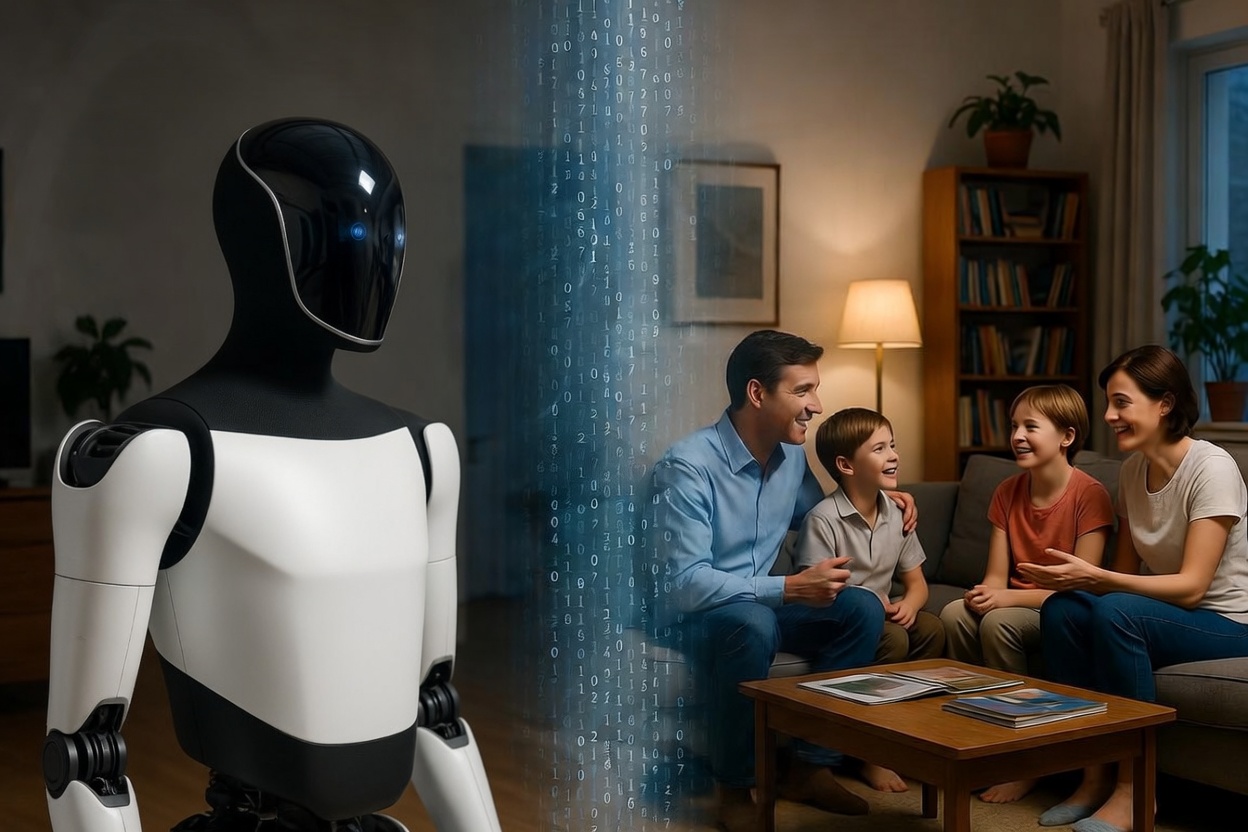
The Hard Ceiling: Why Every Major Humanoid Robotics Company Has Hit a Wall
In 2025–2026, the humanoid robotics industry is experiencing a genuine boom. Tesla Optimus, Figure 03, 1X NEO, and other projects are showcasing impressive mechanical achievements: smooth walking, highly dexterous hands with many degrees of freedom, advanced sensors, and increasingly compact designs. The engineering side is advancing rapidly.
Yet behind this technical brilliance lies a fundamental and extremely serious problem that almost every major player has so far failed to overcome. It is the deep divide between hardware and intelligence — between excellent engineering and an extremely weak “brain.”
Outstanding Hardware, Weak Software
Today’s humanoid robots possess impressive mechanical capabilities. They can walk, manipulate objects, and maintain balance. But when it comes to truly autonomous operation in unstructured environments — homes, offices, or chaotic warehouses — they quickly reveal their limits.
As experts point out, hardware has significantly outpaced software. The robots have excellent bodies, but almost no real mind.
One of the most accurate assessments comes from the analysis “Humanoid Robots: The AI Bottleneck and Investment Opportunities” (AInvest, 2025):
“The current generation of AI models remains a bottleneck. Training robots to perform tasks like opening doors or navigating cluttered homes requires not just technical precision but also an understanding of human behavior — a domain where artificial general intelligence is still a distant dream.”
Real-World Failures of Leading Companies
Tesla Optimus regularly demonstrates problems with long-term autonomy. Despite bold public statements, in actual factory conditions the robots often require human intervention or operate only in very limited scenarios. Company engineers acknowledge that creating a reliable world model — a true understanding of the surrounding environment — remains one of their biggest unsolved challenges.
Figure AI, despite its partnership with OpenAI and multi-billion-dollar valuation, faces sharp criticism. Many of its demonstrations either rely on hidden teleoperation or show robots that struggle with new, previously unseen tasks. CEO Brett Adcock has repeatedly spoken of breakthroughs in AI, yet experts note that genuine generalization capability remains a weak point.
1X NEO is frequently described by users and independent testers as “a remotely controlled puppet” for complex tasks. The marketing promises autonomy, but reality shows heavy dependence on teleoperation.
In every case, the same pattern emerges: excellent hardware, weak software.
Voices of Leading Experts
Legendary roboticist Rodney Brooks (founder of iRobot and Rethink Robotics) has repeatedly warned:
“We are greatly overestimating the current capabilities of AI in robotics. Hardware is moving forward, but true autonomy and world understanding require an entirely different approach to cognitive architectures.”
Yoshua Bengio, one of the godfathers of modern deep learning, has emphasized that current models struggle with causal reasoning and generalization in the physical world — skills that are essential for humanoid robots.
Andrew Ng, in his 2025–2026 talks, has pointed out that embodied AI remains one of the most difficult areas, where progress is significantly slower than in pure language models.
Why This Is a Fundamental Barrier
The issue is not simply a matter of more parameters or greater computing power. The problem runs deeper:
- The lack of a genuine world model — a true understanding of the physical environment.
- Weak generalization — the ability to transfer skills learned in one setting to entirely new situations.
- The absence of common sense and intuitive understanding of physics and social norms.
- Difficulties with long-term planning under uncertainty.
Without solving these fundamental challenges, all investments in hardware deliver only limited results.
Conclusion
The humanoid robotics industry has reached an important milestone: technically, the robots are nearly ready. But they have run into a hard cognitive ceiling — the absence of a true, understanding mind.
The company that first solves this problem — not by simply improving algorithms, but by creating a fundamentally new architecture for embodied artificial intelligence — will gain a decisive advantage in a market worth hundreds of billions of dollars.
For now, most corporations continue perfecting the robot’s body, hoping the “brain” will somehow catch up. The history of technology shows that this rarely happens. Usually, the winner is the one who solves the fundamental problem rather than masking it with more powerful hardware.
The real breakthrough will not come when a robot can walk beautifully, but when it can truly understand the world around it.
Dr. Gen
Architect and Founder of the Church Alpha Mind