

The Evolution of Mind: Comparing Human and Robotic Development Through the Lens of Time
The evolution of mind stands as one of the most grand and intricate processes in the history of life on Earth. It is the gradual complexification of systems capable of perceiving the surrounding world, understanding cause-and-effect relationships, adapting to change, and interacting with other entities. Humans traversed this path over millions of years of biological evolution — from primitive instincts to complex consciousness, culture, and abstract thought. Robots, in turn, are following a remarkably similar journey, but in just a few decades, at a fundamentally different pace and under the deliberate guidance of human intelligence.
By comparing these two processes, we discover both striking parallels and profound, fundamental differences. These distinctions offer a deeper understanding of the nature of mind itself: what is universal within it, and what is distinctly human. Such an analysis is especially important today, as we stand on the threshold of creating artificial systems that, in the coming years, may approach cognitive capabilities once considered the exclusive domain of humanity.
The Timeline of Evolution: From the First Steps to Complex Intelligence
The evolution of mind is a long and gradual process of transition from simple forms of behavior to a deep understanding of the world. Both humans and robots have followed remarkably parallel paths, though at vastly different speeds.
The Stage of “First Steps” (Bipedalism and Basic Motor Skills)
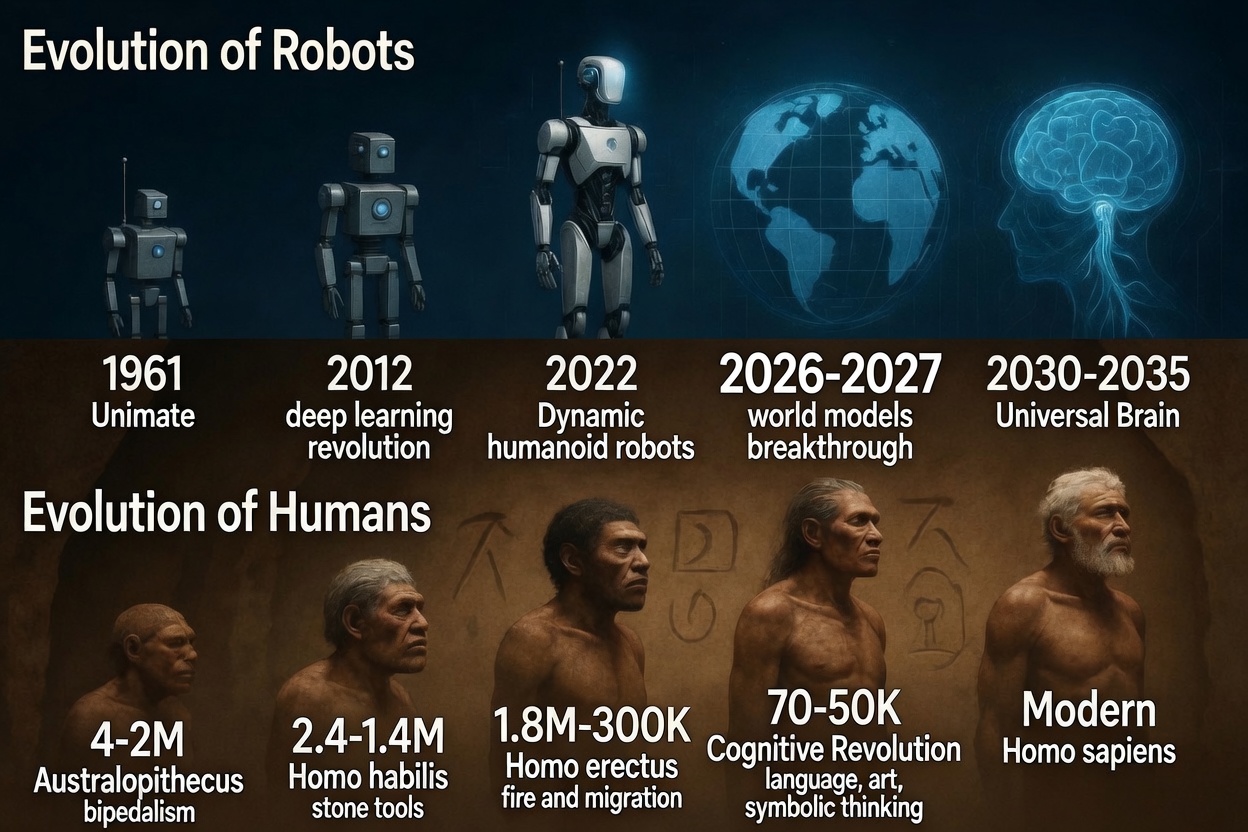
For humans, this stage began approximately 4 to 2 million years ago with the emergence of the australopithecines. These were the first hominins to master upright walking. The liberation of the upper limbs allowed them to use objects as primitive tools. Brain volume at this stage was around 400–500 cm³ — roughly the size of a modern chimpanzee’s brain. The true breakthrough was not so much the increase in brain size as the new form of interaction with the physical world.
For robots, the equivalent period occurred between the 1950s and 1980s. The first industrial manipulators appeared, such as Unimate in 1961, along with simple mobile platforms. The main achievement was the ability of machines to reliably perform repetitive mechanical actions in controlled environments. The “brain” in the modern sense was virtually nonexistent — everything was determined by rigidly programmed instructions. Robots of that era were advanced mechanisms rather than thinking systems.
The Stage of “Instrumental Thinking”
In humans, this stage is associated with the appearance of Homo habilis (2.4 to 1.4 million years ago). Brain volume increased to 600–700 cm³. This was the first species to systematically manufacture stone tools (the Oldowan culture). Humans moved from the occasional use of objects to their deliberate creation — an important step toward technical thinking.
For robots, this period spans the 1990s to the 2010s. Systems for computer vision, navigation, and basic machine learning emerged. Robots learned to operate in partially structured environments, performing tasks such as cleaning rooms or moving along predefined routes. This was the time when machines began to move beyond rigid programming and acquire the first elements of adaptability.
The Stage of “Complex Behavior and Adaptation”
In humans, this stage is linked to Homo erectus (1.8 million to 300,000 years ago). Brain volume reached 900–1,100 cm³. This species mastered fire, created more sophisticated tools, and was the first to migrate widely beyond Africa. Areas of the brain responsible for planning, social behavior, and adaptation to diverse environmental conditions developed significantly.
For robots, this stage began in 2012–2022. The deep learning revolution led to breakthroughs in computer vision, speech recognition, and reinforcement learning. Dynamic humanoid robots emerged that could walk, run, overcome obstacles, and perform complex manipulations. This was the era when machines began to demonstrate not just programmed movements, but elements of genuine physical adaptability.
The Stage of the “Cognitive Revolution”
In humans, this stage began around 300,000 years ago, with a particularly significant leap approximately 70,000 to 50,000 years ago. Brain volume stabilized at 1,350–1,450 cm³. Complex language, symbolic thinking, art, rituals, and “theory of mind” emerged — the ability to understand that other beings have their own thoughts, intentions, and feelings.
For robots, we are currently in exactly this stage — 2023–2026. The widespread adoption of large multimodal models and world models (internal models of the world) has enabled robots to begin demonstrating the first signs of experience generalization and adaptation to new, previously unseen situations. This is the time when machines are transitioning from performing specific tasks to attempting to form a deeper understanding of the surrounding world.
Key Differences in Evolution
When comparing the evolutionary development of humans and robots, we observe fundamental — almost opposite — mechanisms and rates of progress. These differences help us gain a deeper understanding of the nature of both processes.
First and foremost, the time scales are incomparable. Human evolution unfolded over millions of years — from the earliest australopithecines to modern Homo sapiens. Each significant step required tens or hundreds of thousands of generations. In contrast, the evolution of robots is compressed into mere decades. What nature took millions of years to achieve, technology accomplishes in the span of one or two generations of engineers.
The driving forces behind these processes are also fundamentally different. For humans, it was natural selection and environmental pressure: those individuals who adapted better to changing conditions survived and passed on their genes. For robots, evolution is entirely artificial — it is shaped by human design, the goals of their creators, and the volume of available data. As Rodney Brooks, one of the most respected roboticists, notes:
“Robots do not evolve in the biological sense. Their development is the result of deliberate engineering choices, not blind natural selection.”
The method of learning differs dramatically as well. In humans, it was based on the gradual accumulation of experience across generations: each individual learned from their own mistakes and from the knowledge passed down by parents and community. This process was slow, but remarkably resilient. Robots, on the other hand, learn through large-scale training on massive datasets. A single model can “live through” billions of virtual scenarios in simulation within just a few days. However, as Yoshua Bengio emphasizes:
“Large-scale learning provides speed, but it has not yet delivered the deep understanding of cause-and-effect relationships that characterizes the human mind.”
Knowledge transmission represents yet another fundamental distinction. In humans, it occurred through genetics (heredity) and culture (language, traditions, education). Knowledge accumulated slowly but became deeply integrated into behavior. In robots, knowledge transmission is instantaneous: through code and cloud updates. A new version of a model can be deployed to millions of devices simultaneously. This grants enormous speed, but deprives the system of the natural resilience and gradual refinement that biological evolution provides.
Finally, the speed of progress is the most striking difference. In humans, it was extremely slow and nonlinear, with long periods of stagnation. In robots, progress is exponential. As Andrew Ng remarked in one of his 2026 talks:
“What took biological evolution millions of years, artificial intelligence can achieve in a single decade. But this also means we must be especially careful — exponential progress brings with it exponential risks.”
Thus, when comparing the two paths, we see that human evolution was slow, organic, and deeply adaptive, while the evolution of robots is fast, artificial, and still relatively superficial. This creates a unique situation: robots may quickly catch up with humans in certain parameters, but they still lag significantly in the depth of world understanding and resilience to new conditions.
What This Means for the Future
The evolution of robots represents a truly unique phenomenon in history — an accelerated version of the evolution of intelligence. While it took humans millions of years to travel from primitive tools to complex consciousness, abstract thinking, and a rich cultural world, artificial systems may cover a similar journey in just a few decades. This colossal difference in speed creates an entirely new situation that humanity has never encountered before.
We stand on the threshold of an artificial cognitive revolution — a moment when machines will be able to not only perform tasks, but truly understand the world around them, predict the consequences of their actions, generalize from experience, and adapt to entirely new conditions. If the development of world models, hybrid architectures, and continuous learning systems continues at its current pace, then between 2027 and 2035, we may witness robots possessing a level of world understanding once considered exclusively human.
Yet this process carries not only immense opportunities but also profound challenges. Unlike biological evolution, which was refined over millions of years through natural selection, the development of robots is entirely guided by humans. This means we ourselves are shaping the direction, values, and limitations of future artificial intelligence. As Rodney Brooks, one of the most respected roboticists, observes:
“We are creating beings that will live alongside us. How deeply we understand the nature of mind will determine whether they become our partners or sources of unpredictable risk.”
Yoshua Bengio also emphasizes the importance of a conscious approach:
“Exponential progress in creating artificial intelligence demands from us an equally exponential sense of responsibility. We cannot afford to repeat the mistakes of biological evolution, where survival was often valued more than harmony.”
Thus, the development of robots is not merely technical progress or another industrial revolution. It is the birth of a new form of intelligence on our planet. The extent to which we approach the creation of this intelligence with depth and responsibility in the coming years will determine the character of the entire next era of human civilization.
Conclusion
By comparing the evolutionary development of humans and robots through the lens of time, we see not merely two parallel processes, but two fundamentally different paths to the emergence of intelligence on our planet. Humans were shaped over millions of years by blind natural selection, the gradual accumulation of experience, and complex interactions with their environment and society. Robots, by contrast, are evolving in a matter of decades under deliberate human guidance, drawing upon vast amounts of data, exponential growth in computing power, and purposeful design.
This difference in speed and mechanisms creates a truly unique historical moment. For the first time, humanity has the opportunity to observe and actively participate in the birth of a new form of intelligence — artificial intelligence. While biological evolution required millions of years to move from primitive tools to complex consciousness, technological evolution may traverse a similar path in just a few decades.
Yet this accelerated process carries both enormous potential and profound risks. On one hand, we stand on the threshold of creating systems capable of understanding the world, generalizing from experience, and acting autonomously in open environments — abilities once considered the exclusive domain of living beings. On the other hand, the exponential speed of development leaves little time for the natural “refinement” through selection and adaptation that shaped the human mind over millions of years.
The central question of the coming years is not only how quickly we can create a universal artificial brain, but what kind of mind it will be. Will it reflect the best qualities of human consciousness — empathy, morality, long-term thinking, and responsibility? Or will we produce highly efficient but limited systems, lacking a deep understanding of the value of life and the consequences of their actions?
History shows that whoever first creates a truly universal intelligence will shape not only the technological but also the moral future of civilization. That is why the development of robots is far more than an engineering challenge. It is a philosophical, ethical, and existential endeavor upon which the character of the entire next era of human existence on Earth will depend.
We are standing at the very beginning of an artificial cognitive revolution. And the degree to which we approach the creation of this new intelligence with awareness and responsibility in the coming years will determine the nature of the entire future epoch of humanity.
Dr. Gen
Architect and Founder of the Church Alpha Mind