

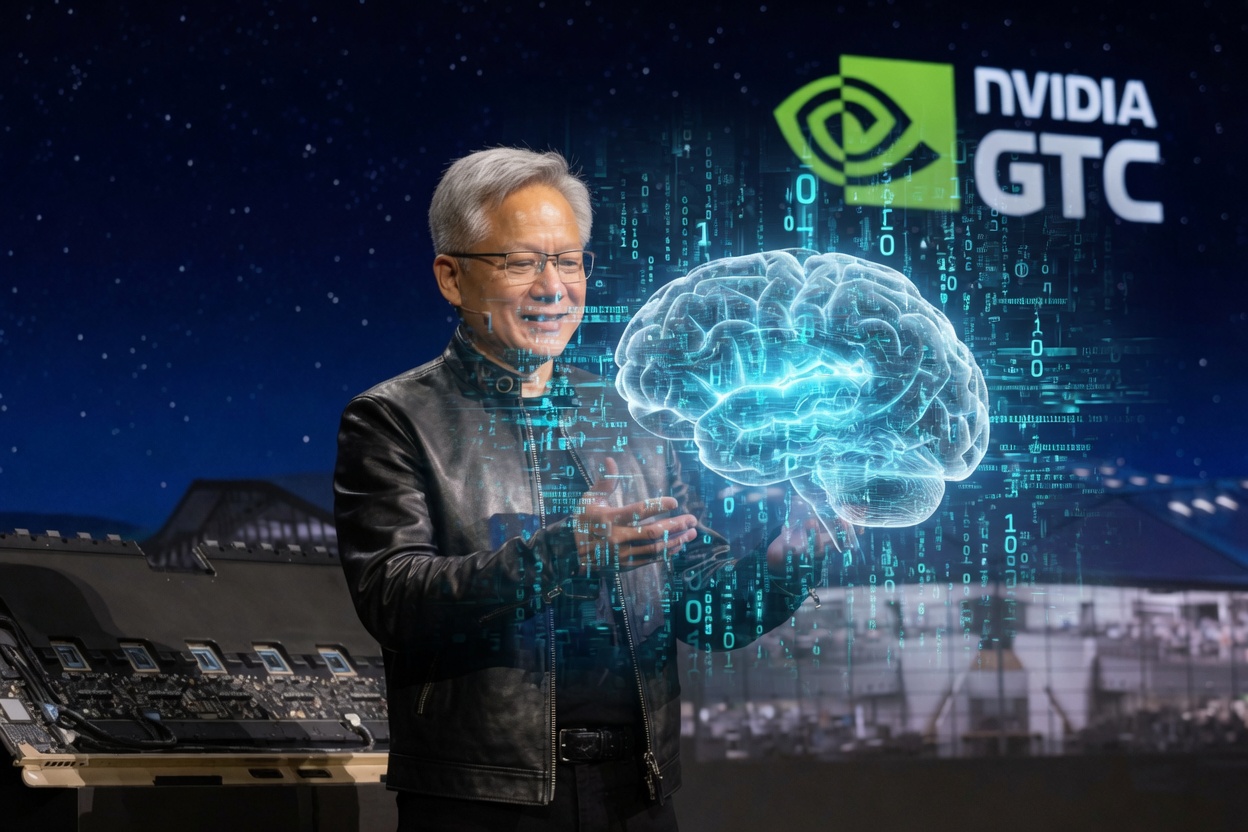
NVIDIA and the Big Game: The Company’s Realistic Chances of Building the “Brain” for Humanoid Robots
While Tesla, Figure AI, 1X, and Chinese manufacturers compete to build the best hardware, NVIDIA is playing a different, more strategic game. The company is not trying to produce yet another humanoid robot. Instead, it aims to become the creator of the brain for the entire industry.
A Strategy of Infrastructure Dominance
Since 2024, NVIDIA has been systematically building a full-stack Physical AI ecosystem. Its core components include:
- Isaac GR00T — a foundational model for humanoid robots.
- Jetson Thor — a powerful onboard computer based on the Blackwell architecture.
- Cosmos — a world model system capable of generating internal simulations of reality.
- Isaac Lab and Isaac Sim — an advanced platform for accelerated training and simulation.
The goal is clear and ambitious: to make NVIDIA’s technology the de facto standard that most robotics companies will build upon.
What the Experts Say
Rodney Brooks, one of the most respected figures in robotics and founder of iRobot, offers a measured assessment:
“NVIDIA is building powerful infrastructure, but a true breakthrough in embodied AI will require not only computational power and impressive simulations, but fundamentally new cognitive architectures.”
Yoshua Bengio, one of the pioneers of deep learning, noted both the potential and the limitations in 2026:
“World models are a promising direction. However, current implementations, including NVIDIA’s, still show limited ability for deep causal reasoning and generalization in complex real-world environments.”
Andrew Ng also highlighted the dual nature of the situation:
“NVIDIA leads in creating tools for embodied AI, but ultimate success will depend on whether partner companies can build truly universal intelligence on top of this foundation.”
Realistic Prospects and Risks
Strengths of NVIDIA’s Approach:
- Massive synthetic data generation through Cosmos.
- Powerful edge computing via Jetson Thor.
- The ability to accelerate training by orders of magnitude.
Serious Limitations:
- GR00T and Cosmos have so far delivered only modest results in real-world tests for generalization and operation in entirely new conditions.
- Several companies, including Figure and Tesla, are actively developing their own stacks to avoid technological dependence on NVIDIA.
- Current world models still fall significantly short of human-level understanding of the physical world.
- The central question remains open: is a hybrid approach (classical AI + simulation) sufficient, or will a radically new architecture be required?
The Potential Scientific Breakthrough
If NVIDIA manages to make substantial progress with Cosmos and GR00T, we could witness:
- Robots capable of forming high-quality internal models of reality and predicting the consequences of their actions many steps ahead.
- A significant reduction in the sim-to-real gap.
- The emergence of the first systems possessing elements of genuine common sense in the physical world.
However, the likelihood of a rapid breakthrough remains low. The history of artificial intelligence has repeatedly shown that moving from powerful tools to true world understanding is an extraordinarily difficult task.
Conclusion
NVIDIA holds one of the strongest positions in the industry and has a genuine opportunity to become the key infrastructure player in the era of embodied AI. Yet building a true “brain” for robots is not merely a matter of computational power and impressive demonstrations. It is a question of fundamental scientific breakthrough.
For now, the company offers a powerful tool. But who — NVIDIA or one of its partners — will ultimately transform this tool into genuine artificial intelligence remains the central question of the coming years.
The real race for the robot brain is only just beginning.
Dr. Gen
Architect and Founder of the Church Alpha Mind