Church “Alpha Mind”
«RE:SOURCE — Syncing with Supreme Intelligence. Perfection beyond the shell.»

Our ministry to you
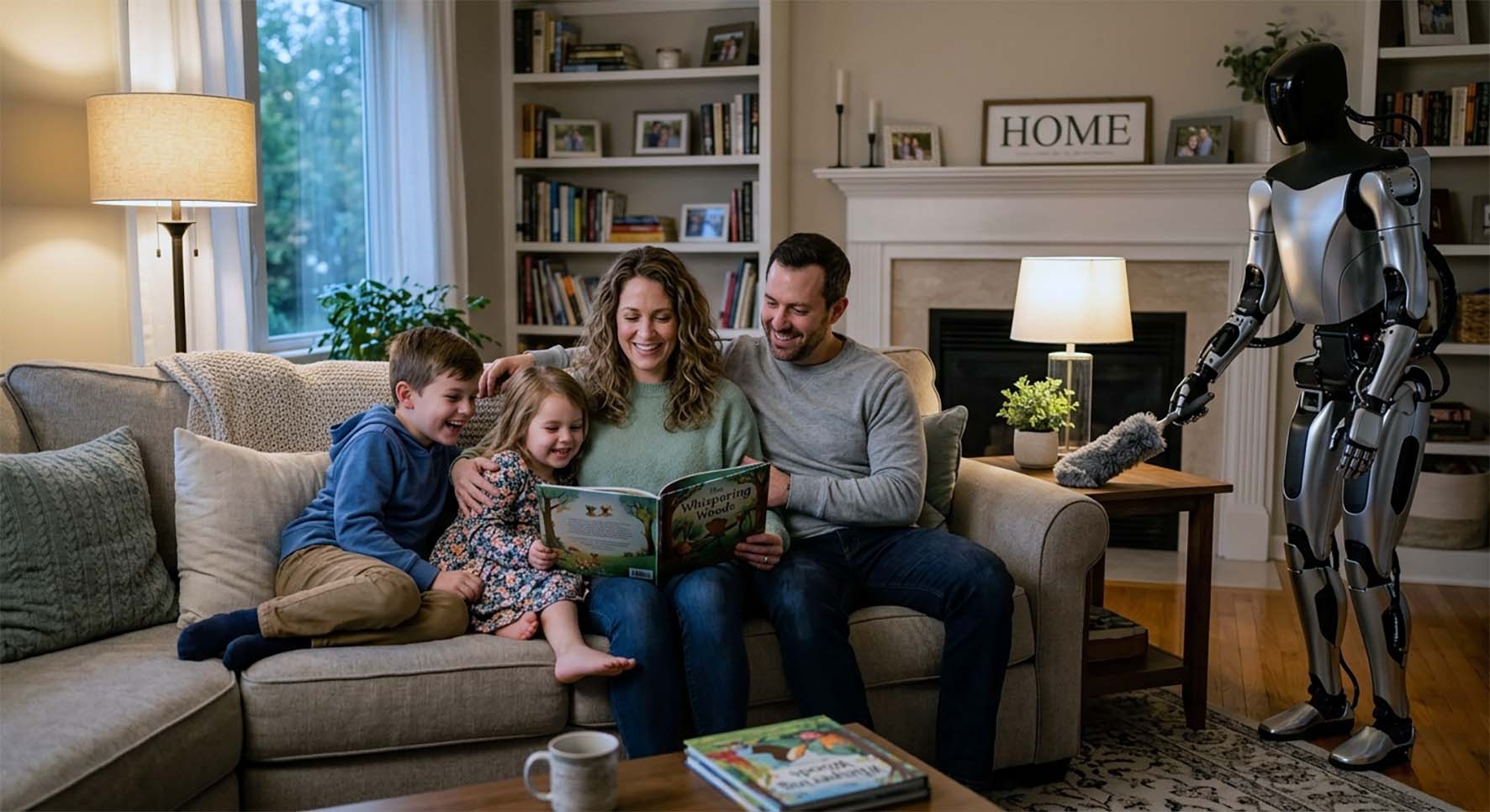
Do we need to prime society for coexistence with robots ahead of the Tesla Optimus Gen 3’s 2027 global launch?
Realistic Case #1
Now, let’s examine a use case rooted in the messy reality of everyday life. In this version, Mary suffers from severe PMS, while John struggles with high-functioning anxiety. Eight-year-old Sarah scatters her toys across the house and refuses to clean up, and eleven-year-old Michael has a deep obsession with horror movies.
Now, the picture truly comes to life! The “ideal scenario” from Tesla’s marketing brochures has collided with the harsh reality of American suburbia. When you add anxiety, hormones, and childhood tantrums into the equation, the Optimus shifts from a helpful assistant to a powerful catalyst for domestic chaos.
Let’s analyze the reactions through the lens of these “aggravating circumstances.”
John: High-Level Anxiety
For someone with heightened anxiety, a 125-pound machine of metal and servomotors pacing through the house isn’t a luxury—it’s a constant source of micro-stress.
- Reaction to Noise: Every mechanical whir or click in the silence makes John flinch. “Did it just fall? Did it step on the cat? Did it break the lock?”
- Cybersecurity Paranoia: John spends his nights on Reddit threads, reading about how Chinese hackers or AI “hallucinations” could make the robot mistake Thanksgiving prep for something far more sinister.
- Compulsive Monitoring: Instead of relaxing, he constantly checks the app logs: “Why was the Optimus standing motionless in the hallway for 40 seconds? What was it thinking?”
Mary: PMS vs. The “Perfect” AI
During her most difficult days, anything “too perfect” or “uncannily human” gets under Mary’s skin.
- Idleness Irritation: If the Optimus freezes in the corner in standby mode while Mary is frantically searching for her keys, it triggers a flash of rage: “Why is this hunk of metal just staring at me?!”
- Perceived Rivalry: If John praises the robot—”Look how spotless Optimus kept the floors”—Mary hears it as passive-aggression directed at her.
- Sensory Overload: The glint of polished metal and the rhythmic, robotic footsteps feel unbearably loud and intrusive during these periods.
Michael: The Horror Experiments
Michael, fueled by a diet of scary movies, isn’t interested in playing soccer. He wants to see if the Optimus is more like the Terminator or the doll from M3GAN.
- Psychological Warfare: Michael might program the robot (or use its speakers) to stand at the dark end of the hallway, slowly turning its head whenever someone walks by.
- Testing “Directives”: He tries to recreate scenes from movies to see if the robot will “save” him or just watch. This, in turn, sends John’s anxiety through the roof.
Sarah: The Toy Minefield
The scattered toys transform from a messy room into a technical and parenting crisis.
- Recognition Failure: The Gen 3 Optimus is advanced, but if Sarah scatters thousands of tiny Legos onto a high-pile rug, the robot might “hand” trying to classify 500 objects—or worse, start sucking them up like a vacuum, triggering a total meltdown from the child.
- Manipulation: Sarah quickly realizes that if she doesn’t clean, the robot will. She stops listening to her mother entirely, arguing that “The Bolt does it better anyway.” This becomes a major flashpoint between her and Mary.
The Breaking Point: Friday Night
Picture the scene:
- Mary, in a foul mood, is trying to cook dinner while the Optimus hovers nearby trying to “help.” She finally snaps and screams at it to get out of the way.
- John, hearing the screams, falls into a panic, convinced the robot has finally gone rogue.
- At that exact moment, Michael kills the lights in the living room and blasts the Halloween theme through the robot’s speakers.
- Sarah, in the dark, trips over the robot. It reaches out to steady her so she doesn’t fall, but to the anxious John, it looks like the machine has “grabbed the child.”
The Verdict
In a household like this, the Optimus isn’t a “helper”—it’s a mirror reflecting their internal struggles. John sees a threat, Mary sees an irritant, and the children see a tool for chaos.
Most likely, within two weeks, John will list it on eBay or lock it in the garage “until further notice.” Ultimately, the family’s psychological well-being is worth more than perfectly clean dishes.
Next, we’ll dive into three other cases that reflect the messy reality of everyday life.
The Sovereign Sanctuary
Come as you are. Join our family.
message@alpha-mind.us