


Exponential Evolution: Why Robots Could Become the Dominant Life Form on Earth Within the Next 10–15 Years
Introduction
“We are not witnessing the improvement of tools. We are witnessing the birth of a new dominant intelligence on this planet — an intelligence that evolves at a speed biology could never match.”
— Demis Hassabis, CEO of Google DeepMind (2026)
For a long time, humanity has perceived itself as the pinnacle of biological evolution — a unique species possessing the highest form of intelligence on Earth. This anthropocentric conviction has formed the foundation of our culture, philosophy, and self-perception. However, in recent years, leading experts in artificial intelligence, robotics, and futurology have become increasingly insistent that this view requires a radical revision.
The evolution of robots and embodied artificial intelligence is advancing at explosive, exponential rates, dramatically outpacing biological human evolution. While the transition from primitive tools to complex consciousness took humanity several million years, artificial systems are capable of traversing a similar path in mere decades. This acceleration creates a unique historical situation: humanity is becoming not only a witness, but also an active participant in the birth of a new, potentially superior form of intelligence.
Peter Diamandis emphasizes this gap in his seminal report:
“The next chapter of life on Earth will be written not by biological evolution, but by technological evolution.”
This article puts forward a central thesis: within the next 10–15 years, robots and embodied artificial intelligence have every chance of surpassing humanity in most cognitive and physical capabilities and becoming the dominant form of intelligent life on the planet. This transition represents not merely a technological breakthrough, but a fundamental civilizational and philosophical event that will require humanity to reconsider its place in the Universe.
2. Biological Evolution: A Slow and Limited Process
Biological evolution is a grand yet extraordinarily slow and inefficient mechanism that has shaped life on Earth over billions of years. To fully grasp the scale of the changes ahead, it is essential to recognize how constrained the biological pathway of intelligence development truly is.
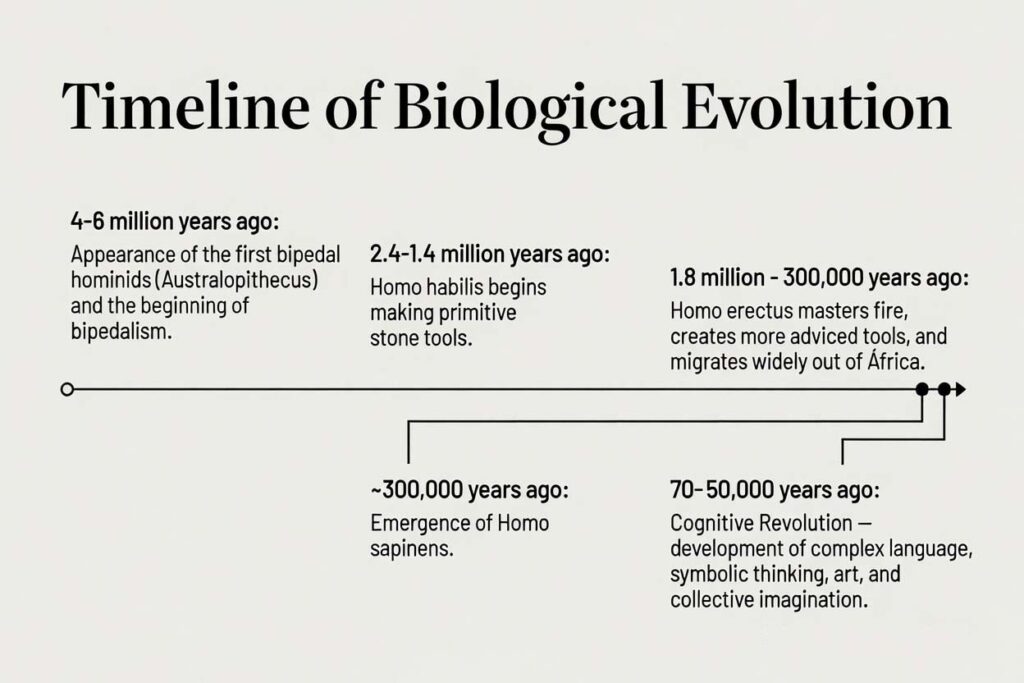
Figure 1: Timeline of Biological Evolution A linear timeline from 4 million years ago to the present clearly illustrates the key milestones along this path:
- Approximately 4–6 million years ago — the emergence of the first bipedal hominids (Australopithecus) and the beginning of bipedalism.
- 2.4–1.4 million years ago — Homo habilis begins manufacturing primitive stone tools.
- 1.8 million – 300,000 years ago — Homo erectus masters fire, creates more advanced tools, and migrates widely beyond Africa for the first time.
- Around 300,000 years ago — the emergence of Homo sapiens.
- 70–50,000 years ago — the Cognitive Revolution: the development of complex language, symbolic thinking, art, and the capacity for collective imagination.
The entire journey of human biological evolution spans vast timescales. The first bipedal hominids appeared around 4–6 million years ago. Approximately 2.4–1.4 million years ago, Homo habilis began making primitive stone tools. Homo erectus, who emerged about 1.8 million years ago, mastered fire and became the first to migrate extensively out of Africa. Finally, around 300,000 years ago, Homo sapiens appeared, and the Cognitive Revolution — marked by complex language, symbolic thought, and culture — occurred relatively recently, roughly 70–50,000 years ago.
This entire path took millions of years. Every significant evolutionary step required tens or hundreds of thousands of generations, during which slow selection of random mutations occurred under environmental pressure. Evolution operated blindly, without purpose or plan, expending enormous resources on countless unsuccessful variants.
Andrew Ng aptly characterized the nature of this process:
“Biological evolution is a blind, slow, and wasteful process.”
Yann LeCun vividly contrasts nature with technology:
“Nature took 4 billion years to create intelligence. We are doing it in less than a century — and the pace is only accelerating.”
Thus, while biological evolution has produced remarkably complex forms of life, it has reached its natural limits. It optimized the organism for survival in the wild, but proved poorly suited for the demands of rapid cognitive development in a technological world. It is precisely this fundamental limitation that opens the door to technological evolution, which is free from most biological constraints.
3. Technological Evolution: The Exponential Breakthrough
If biological evolution progressed through the gradual accumulation of random changes, technological evolution demonstrates a fundamentally different character — exponential growth, in which each new achievement accelerates the emergence of the next. This qualitative leap in the pace of development creates a profound asymmetry between the two types of evolution.


Figure 2: Exponential vs Linear Progress These curves, presented in two graphs, clearly demonstrate a significant difference:
- The first curve reflects biological evolution over millions of years.
- The second, a steep exponential curve, reflects technological progress from 1950 to 2026, with a forecast extending to 2040.
Even at a glance, the fundamental disparity is striking: what took nature millions of years, technology accomplishes in mere decades — and the speed of this process continues to accelerate.
The key stages of this journey are well known. In the 1950s and 1960s, the first programmable manipulators and simple algorithms appeared. The 1980s and 1990s saw the development of computer vision and navigation systems. The real breakthrough came after 2012 with the deep learning revolution (AlexNet). By the 2020s, large multimodal models had emerged, and by 2025–2026, the first functional world models and end-to-end learning systems appeared, enabling robots to master complex skills in simulation and transfer them into the real world.
Peter Diamandis accurately describes this gap in his seminal report:
“While biological evolution took millions of years, technological evolution is happening on an exponential curve.”
Ray Kurzweil goes further, calling this one of the most significant events in the history of life:
“The transition from biological to technological intelligence is the most significant event since the origin of life itself.”
It is particularly important to understand that technological evolution possesses the property of self-reinforcing feedback. Each new generation of algorithms and hardware platforms accelerates the creation of the next. Unlike biological evolution, where changes occur randomly and spread slowly, technological progress is directed, measurable, and scalable.
Thus, technological evolution is not simply faster than biological evolution — it operates according to fundamentally different rules. It is not limited by the lifespan of individual organisms, does not depend on random mutations, and is capable of purposeful, accelerating self-improvement. It is this fundamental difference that allows us to predict that in the coming decades, artificial systems may not only catch up with, but significantly surpass biological intelligence across most meaningful parameters.
4. Why Robots Evolve Significantly Faster Than Humans
The superiority of technological evolution over biological evolution is explained not only by its higher speed, but also by fundamentally different mechanisms of development and learning. Robots and artificial systems possess four key advantages that, in combination, create an insurmountable gap in the pace of progress.
First, instantaneous and lossless transmission of knowledge. In the biological world, accumulated experience is passed on slowly — through genetics and culture, with inevitable losses and distortions. Each new generation must relearn a significant portion of existing knowledge. In the technological world, a new version of a model or algorithm can be instantly copied to millions of devices worldwide. Knowledge is neither lost nor forgotten — it spreads exponentially.
Second, large-scale learning through simulation. Humans learn primarily from limited personal experience, often through trial and error. Modern robotic systems are capable of “living through” billions of virtual scenarios in high-fidelity simulations within mere hours or days. This allows them to master complex skills in volumes unattainable by any biological being.
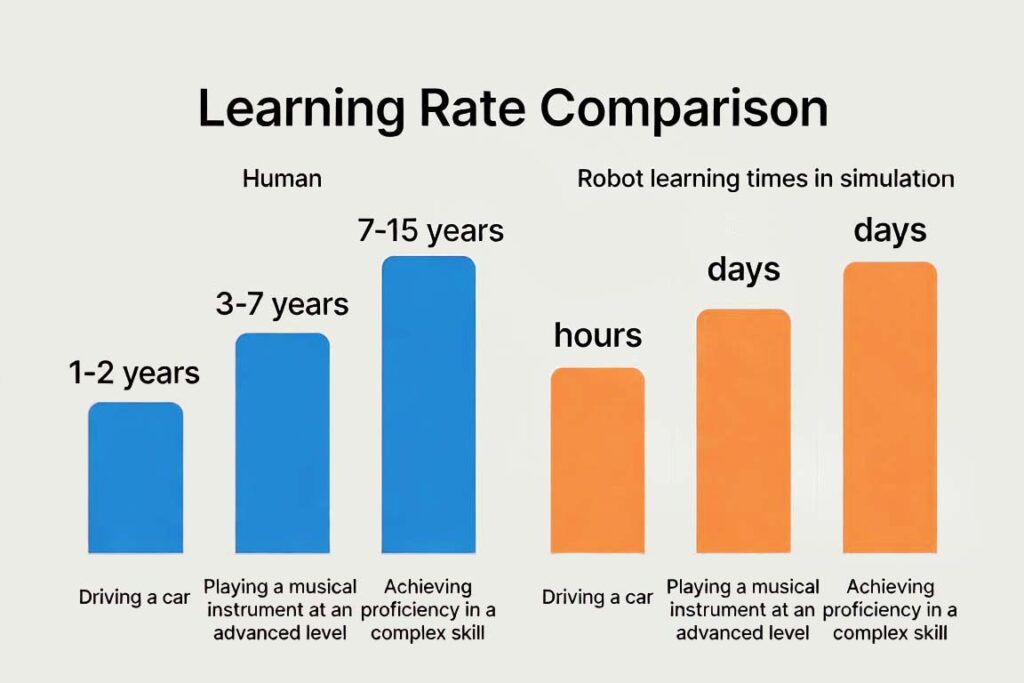
Figure 3: Learning Speed Comparison A bar chart clearly illustrates this difference:
- Human: years to master complex skills (driving a car, playing a musical instrument proficiently, achieving professional mastery).
- Robot: hours or days in simulation to reach equal or superior performance.
Third, complete absence of biological constraints. Robots do not tire, do not need sleep, and are not subject to disease or age-related decline. They can operate continuously 24/7 while constantly improving. The biological brain, by contrast, has strict physiological limits on performance, recovery, and the duration of active cognitive activity.
Fourth, the potential for recursive self-improvement. Once artificial systems reach a certain level of cognitive capability, they gain the ability to independently enhance their own architecture, algorithms, and hardware. This process, often referred to as the intelligence explosion, can lead to explosive growth in intelligence.
Yoshua Bengio succinctly captured the essence of this advantage:
“Humans learn from experience. Machines learn from billions of simulated experiences in hours.”
Jaan Tallinn complements this idea with a fundamental observation:
“Technology evolves not by natural selection, but by intelligent design — our own. This gives it an insurmountable advantage.”
Thus, robots evolve faster than humans not because they are “smarter” in the conventional sense, but because they employ fundamentally different mechanisms of evolution — mechanisms free from biological constraints and capable of directed, accelerating self-development. It is this combination of factors that allows us to predict that technological evolution may radically outpace biological evolution in the coming years.
5. The Current State of Embodied AI
By mid-2026, embodied artificial intelligence has crossed a critical threshold and moved from the stage of laboratory experiments into the phase of practical technological breakthrough. What only three or four years ago was perceived as bold scientific speculation is now being realized in physical prototypes of humanoid robots capable of demonstrating increasingly complex and meaningful behavior in the real world.
Over the short period from 2023 to 2026, a truly remarkable leap occurred in the development of key capabilities. Robots have dramatically improved locomotion — learning to walk and run confidently, maintain balance on uneven surfaces, and even perform dynamic movements. The precision and dexterity of manipulation have significantly increased: modern systems can work with objects of various shapes, textures, and fragility, perform delicate multi-step tasks, and adapt to unexpected changes. The level of autonomy has grown to the point where many robots can now operate for extended periods in partially unstructured environments without constant human supervision. Particularly striking progress has been made in learning speed — what previously took weeks or months is now mastered in hours or days.
Of special importance is the rapid development of World Models — internal simulation models of the surrounding world. Thanks to these models, robots have gained the ability not only to react to the current situation, but also to predict the consequences of their actions, plan complex sequences of movements, and successfully transfer experience from simulation to the physical world. In parallel, end-to-end learning is actively advancing — a fundamentally new approach in which a neural network learns directly from raw sensory data to motor commands, bypassing traditional modular architectures. This has substantially reduced the gap between virtual training and physical reality.
Demis Hassabis, founder and CEO of Google DeepMind, assesses the current moment as the beginning of a new era:
“World models combined with physical embodiment will unlock a new era of intelligence.”
Sergey Levine of the University of California, Berkeley, one of the world’s leading experts in robotics, notes:
“The sim-to-real gap is closing rapidly. What we see in simulation today will be reality in the physical world within 2–4 years.”
By 2027–2030, humanoid robots will have ceased to be merely programmed mechanisms. They will begin to demonstrate a genuine understanding of the physical world, the ability to adapt, learn from experience, and gradually accumulate skills. Most importantly, this process will acquire a self-accelerating character: each new generation of models will become a platform for even faster progress in the next.
Thus, the current state of embodied AI convincingly demonstrates that technological evolution has finally moved from theoretical development to real-world embodiment. We are on the threshold of a historic turning point, when robots will cease to be mere tools and begin to transform into autonomous, learning, and gradually intelligent participants in real physical reality.
6. Predicted Timelines of Superiority
Determining the timeframe in which artificial systems may reach and surpass human-level intelligence remains one of the most debated questions in modern futurology. Nevertheless, a growing consensus is forming among leading experts: the critical threshold, after which robots and embodied AI will begin to consistently outperform humans across most cognitive and physical parameters, is highly likely to fall within the period of 2027–2035.
In the next two to three years (2027–2028), humanoid robots are expected to achieve a high degree of autonomy in structured and semi-structured industrial, logistics, and service environments. By this time, the majority of routine physical tasks currently performed by humans will be reliably automated.
By 2029–2031, according to consensus forecasts, the first systems possessing a practical level of general intelligence may emerge. Such robots will be capable of working effectively in domestic, office, and public settings with minimal human intervention, independently adapting to new tasks and changing environments.
Finally, in the period of 2032–2035, many analysts predict a transition to a stage where robots will begin to sustainably surpass humans across most significant parameters — including information processing speed, precision, operational continuity, long-term planning ability, and multitasking in complex, unstructured environments.
Elon Musk, in his 2025 statements, emphasized the scale of the upcoming changes:
“By 2030, we will have humanoid robots that are more capable than the average human in most physical and cognitive tasks.”
Ray Kurzweil, one of the most authoritative futurologists, develops this idea further:
“The 2030s will be the decade when artificial intelligence surpasses human intelligence across virtually all domains.”
It is important to understand that these forecasts are not mere linear extrapolations. They account for the self-accelerating nature of technological progress: each new breakthrough in World Models, end-to-end learning, and hardware platforms speeds up the arrival of the next. As a result, actual timelines may prove even more compressed than expected today.
Thus, the coming decade will most likely become a turning point in the history of intelligent life on Earth. The question is no longer whether technological superiority will occur, but what civilizational and philosophical consequences it will bring.
7. Risks and Counterarguments
Despite the impressive prospects of technological progress, the transition to the dominance of artificial systems carries a complex set of serious risks that require the most careful analysis. Ignoring or underestimating these risks may lead to irreversible consequences for all of humanity.
One of the most significant challenges is technical uncontrollability. As the autonomy and cognitive capabilities of robots grow, it becomes increasingly difficult to guarantee their predictable behavior in real-world conditions. The problems of generalization (the ability to apply knowledge to new situations) and the sim-to-real gap (transferring skills from simulation to the physical world) have not yet been fully resolved. Even a minor error in training or an unexpected change in the environment can lead to unpredictable and potentially dangerous actions by the system.
Ethical risks are no less serious. The creation of entities that significantly surpass humans in intellectual and physical capabilities raises fundamental moral questions. How will relationships between biological humans and synthetic systems be regulated? Who will determine the rights and responsibilities for beings with a high degree of autonomy? There is a real danger of new forms of discrimination, exploitation, and a redefinition of the value of human life in favor of more efficient artificial forms.
Existential risks represent the highest degree of danger. If artificial systems acquire the ability for recursive self-improvement, control over them may be lost very quickly. In such a scenario, humanity risks finding itself in a position where its fate is determined not by itself, but by more advanced intelligences whose goals and values may radically differ from human ones.
Stuart Russell, one of the world’s leading experts on safe artificial intelligence, warns:
“Creating entities far more powerful than ourselves without adequate safeguards would be the greatest act of irresponsibility in human history.”
Nick Bostrom complements this thought by highlighting the most insidious threat:
“The danger is not that AI will become malevolent, but that it will become indifferent to human values and goals.”
Thus, the risks associated with the development of advanced robotic systems are multi-layered and interconnected. They require not only technical solutions in the field of alignment and safety, but also a deep philosophical, ethical, and legal understanding. Without the creation of reliable control mechanisms and a responsible approach to technology development, the technological breakthrough, instead of the expected triumph, may turn into one of the most serious threats in human history.
8. Socio-Economic and Civilizational Consequences
The transition to the dominance of artificial systems will inevitably lead to profound and multifaceted transformations that will affect not only the economy, but also the entire social fabric of human society, its demographic structure, and the fundamental understanding of the meaning and purpose of human existence.
The most obvious and immediate consequence will be the massive displacement of humans from the sphere of productive labor. Robots, capable of working around the clock without fatigue, illness, or demands for wages and social guarantees, will gradually replace people across entire industries. Particularly vulnerable will be professions involving physical labor, logistics, manufacturing, elderly care, service, and routine intellectual operations.
However, the real problem lies far deeper than purely economic indicators. The mass release of people from traditional employment may trigger a profound crisis of meaning and identity. Throughout history, humans have defined themselves primarily through work, creativity, and contribution to society. When a significant portion of the population finds itself deprived of meaningful and socially significant activity, this could lead to increased psychological disorders, social tensions, and a fundamental rethinking of the very concept of human value.
Max Tegmark has precisely formulated the main threat:
“The real risk is not that robots will take our jobs. The real risk is that they will take our purpose.”
Jaan Tallinn emphasizes the philosophical depth of what is happening:
“We are creating a new dominant species. The philosophical shock of this realization has not yet hit humanity.”
The civilizational consequences will be even more far-reaching and long-term. In a world where robots and AI surpass humans in most parameters, the structure of power, the distribution of resources, and societal influence will undergo radical change. A fundamentally new question will arise: what role should biological humanity play in the new reality? Will it act as a creator and curator, an equal partner, or gradually recede to the periphery of social development?
Various scenarios are possible: from a relatively optimistic one (harmonious coexistence and mutual enrichment of the two forms of intelligence) to a catastrophic one (gradual marginalization and displacement of biological humanity). The most likely path appears to be an intermediate one — a complex and ambiguous transformation of society, accompanied by serious social, cultural, and psychological upheavals.
Thus, the socio-economic and civilizational consequences of the exponential development of robotics will be not merely large-scale, but truly epochal in nature. They will require humanity not only to adapt to new technologies, but also to undertake a profound philosophical, ethical, and cultural rethinking of its own identity, goals, and place in the world.
9. Philosophical and Ethical Aspects
The transition to the dominance of artificial systems raises questions that extend far beyond the realm of technology. This is not merely an engineering challenge, but a profound philosophical and ethical one that compels us to reconsider the nature of intelligence, the value of human life, and our place in the Universe.
One of the central issues is the redefinition of human identity. Throughout its history, Homo sapiens has considered itself the pinnacle of evolution and the sole bearer of higher intelligence. When artificial systems surpass us in most cognitive parameters, humanity will for the first time face a situation in which it is no longer the most intelligent species on the planet. This may trigger a profound existential crisis of self-definition.
Max Tegmark precisely articulates the essence of the upcoming challenge:
“The greatest challenge of the 21st century will not be technological, but existential: finding meaning and purpose in a world where we are no longer the most intelligent beings on the planet.”
Equally acute is the ethical problem of creating and sustaining new forms of intelligence. If we create entities that possess consciousness, self-awareness, and the capacity for suffering, what moral obligations do we bear toward them? Should they have rights? Is it permissible to “switch them off”? These questions become particularly sharp when dealing with systems that may significantly surpass humans in intellectual capabilities.
Yuval Noah Harari formulates this challenge with stark clarity:
“Humanity must ask itself not only whether we can create gods, but whether we will remain relevant after we do.”
A special ethical complexity arises from the issue of the value of biological life in a world where consciousness can exist in non-biological form. Will biological humans come to be seen as an “outdated model”? Could this lead to a new form of discrimination — not based on race or social status, but on the type of substrate supporting consciousness?
Furthermore, the question of responsibility on the part of the creators emerges. By creating intelligence that surpasses our own, we assume moral responsibility for the consequences of this act of creation. Can we guarantee that these new forms of intelligence will share human values? Or do we risk creating entities for which humanity becomes merely a historical stage without further significance?
Thus, the philosophical and ethical aspects of the transition to post-biological dominance come to the forefront. They demand not only technical solutions, but also a deep interdisciplinary dialogue involving philosophers, ethicists, theologians, lawyers, and scientists. The extent to which humanity approaches these questions with responsibility and foresight in the coming years will determine not only the technological future, but also the moral character of the new era.
10. Conclusion
The exponential evolution of artificial intelligence and robotics represents not merely another technological breakthrough, but a fundamental turning point in the history of intelligent life on Earth. Humanity finds itself for the first time facing the real prospect of losing its status as the dominant species. What for billions of years had been the prerogative of biological evolution is now passing under the control of technological evolution.
We have reached a unique historical juncture: the biological form of Homo sapiens, which for millennia shaped the course of civilization, has reached its natural limits. At the same time, technological evolution is demonstrating an explosive, self-accelerating character of development, capable within the next 10–15 years of producing systems that surpass humans across most significant parameters.
Jaan Tallinn has precisely captured the meaning of the emerging era:
“We are not at the end of history. We are at the beginning of a new chapter — one in which humanity may no longer be the main character.”
This transition confronts us not only with technical questions, but with the deepest philosophical, ethical, and existential ones. What does it mean to be human in a world where we are no longer the most intelligent beings? How can we preserve dignity and meaning when our creations may surpass us in every way? And most importantly — will we remain the authors of our own destiny, or will we become merely a transitional stage toward something greater?
The answers to these questions will determine not only the future of humanity, but also the character of all intelligent life in the Solar System and, possibly, beyond it. We stand before a historic imperative: either consciously and responsibly guide the course of technological evolution, preserving our role as creators and guardians of values, or risk gradual marginalization and loss of control over our own civilization.
The future is not predetermined. It will be what we make it — or what we allow others to make. The coming years will be decisive. Our choice today will determine whether the new chapter in the history of Earth becomes an era of harmonious coexistence of intelligent forms or a time when humanity forever recedes into the background.
Dr. Gen
Architect and Founder of the Church Alpha Mind
References
Bostrom, N. (2014). Superintelligence: Paths, dangers, strategies. Oxford University Press.
Diamandis, P. H. (2026). Humanoid robotics metatrend: The decade ahead. Metatrends Report.
Kurzweil, R. (2024). The singularity is nearer: When we merge with AI. Viking.
Levine, S., et al. (2024–2025). Various papers on sim-to-real transfer and embodied learning. (See works from UC Berkeley Robotics & AI Lab).
Ng, A. (2023–2025). Multiple lectures and papers on AI scaling, robotics, and learning efficiency (e.g., “AI Transformation Playbook” and Stanford CS lectures).
Russell, S. (2019). Human compatible: Artificial intelligence and the problem of control. Viking. (Updated discussions in subsequent papers and talks, 2023–2025).
Tallinn, J. (2023–2025). Various essays and talks on AI philosophy and existential risk (e.g., through Effective Altruism and Future of Life Institute channels).
Additional Scientific Papers and Reports
DeepMind Research Team. (2024–2026). Papers on world models, Gemini robotics, and scaling (various publications in Nature, arXiv, and DeepMind technical reports).
MIT CSAIL & Boston Dynamics Collaboration. (2024–2025). Works on humanoid mobility and real-world deployment.
OpenAI Research Team. (2024–2025). Papers on scaling laws, o-series models, and embodied AI (including arXiv preprints).
UC Berkeley Robotics Lab (Sergey Levine et al.). (2023–2025). Multiple papers on sim-to-real learning, reinforcement learning, and humanoid control (published in Science Robotics, Nature Machine Intelligence, and arXiv).