

Why Robots Copy Humans: Anthropomorphic Design as the Main Path of Robotics
Part 1. Robotics is Actively Following the Path of Copying the Human Body
Modern robotics demonstrates a clear and powerful trend: instead of radically new forms (wheels, tracks, or multi-legged designs), engineers are increasingly creating anthropomorphic (human-like) robots — with a torso, head, two arms, and two legs.
This is not a tribute to fantasy or aesthetics. It is a pragmatic engineering decision of the highest order. The world was built by humans for humans: stairs, door handles, tools, kitchens, offices, and factories are perfectly adapted to human proportions, height, grip, and gait. A robot that copies the human body gains the ability to operate within existing infrastructure without the need for a multi-billion-dollar redesign of the world around it.
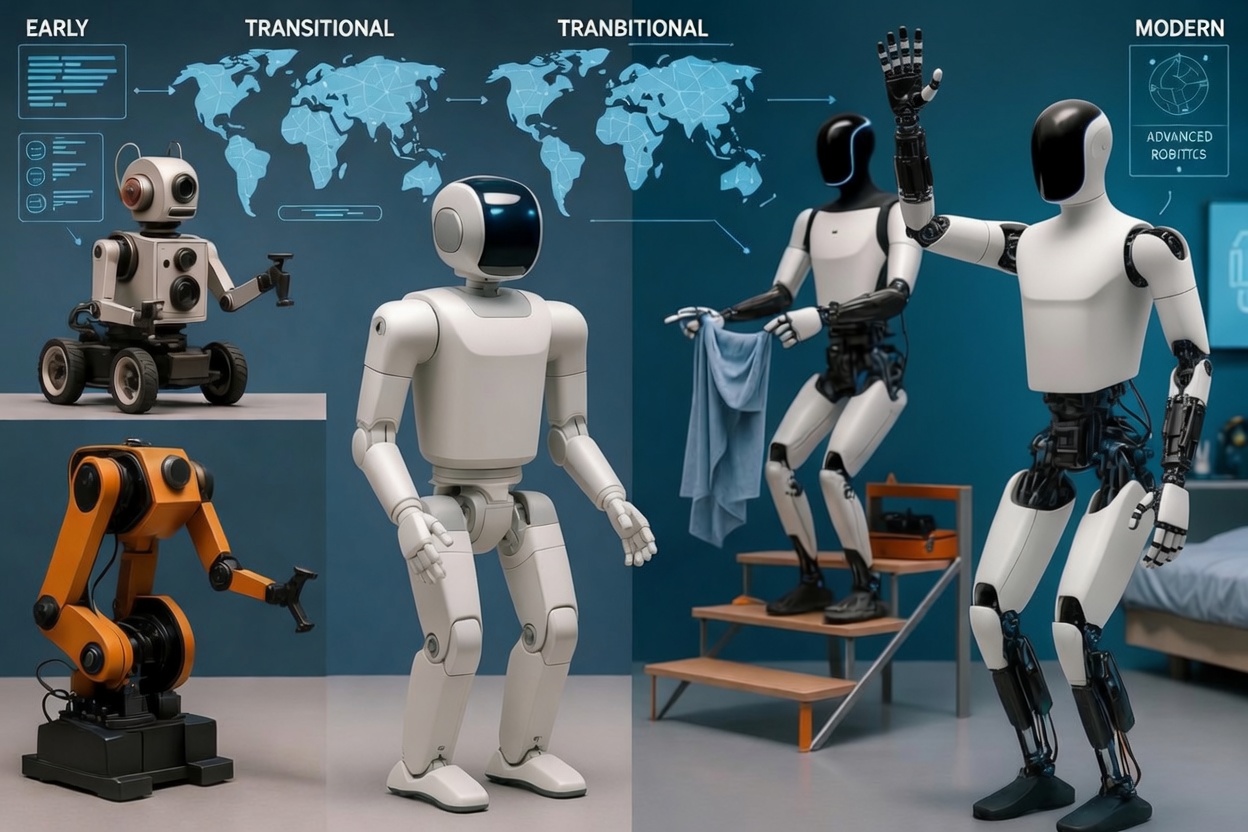
Historical Context and Evolution Early industrial robots were specialized manipulators mounted on fixed bases — highly effective on assembly lines but completely useless beyond them. The transition to mobile humanoid systems began with Honda ASIMO in the early 2000s. Today, this direction is experiencing a true explosion: Tesla Optimus, Figure 01, 1X NEO, Unitree G1, and dozens of other projects.
Why exactly the human form? The main reasons are:
- Compatibility with the environment — the ability to climb stairs, open doors, use standard tools, and work side by side with people.
- Universality — a single platform capable of performing thousands of different tasks, from warehouse logistics to elder care and hazardous operations.
- Natural interaction with humans — a human-like appearance dramatically lowers psychological barriers and allows robots to become genuine companions and assistants.
Specific Examples of Copying Human Body Design
1. Legs and Bipedal Locomotion Human gait is an extremely complex system of dynamic balance, involving center-of-mass shifts, heel-to-toe rolling, and continuous correction. 1X NEO reproduces this with high naturalness thanks to whole-body control and a tendon-drive system that mimics human musculature. The robot confidently moves across domestic surfaces and recovers its balance. Tesla Optimus is also perfecting human-like walking to seamlessly integrate into both factory and home environments (height ≈173 cm, weight ≈57 kg).
2. Arms and Hands — the Pinnacle of Dexterity The human hand consists of 27 bones, dozens of degrees of freedom, and thousands of sensors. Modern robots are actively replicating this engineering marvel:
- Tesla Optimus Gen — hands with 11+ degrees of freedom, capable of gently picking up an egg or folding laundry.
- 1X NEO — 22 degrees of freedom per hand. Tendon-driven actuators provide soft, fast, and safe movements that are remarkably close to human ones.
- Advanced prototypes (Shadow Dexterous Hand, Protoclone, and others) use hundreds of synthetic “muscles” to imitate the complex biomechanics of the human hand.
3. Torso, Head, and Sensing The torso provides balance and strength. The head, equipped with cameras and sensors, serves as the “eyes” and “ears.” Optimus and NEO feature 360° vision, tactile sensors across the body, and advanced AI that enables them to perceive the world much like a human.
Advantages and Challenges Advantages:
- No need to redesign the world for the robot.
- Exceptional universality — from factory floors to homes.
- Natural collaboration with humans.
Challenges:
- Complexity of bipedal stabilization and high energy consumption.
- Hand dexterity still lags behind humans (though the gap is closing rapidly).
- High initial cost, offset only by mass production.
Despite alternative forms, humanoid design is confidently winning wherever true universality is required in human environments.
The Future: From Copying to Symbiosis Robotics is no longer simply copying the body — it is deeply studying biomechanics, neuroscience, and new materials. In perspective, this will lead to genuine technological kinship — the emergence of robots capable of subtle interaction, caregiving, and co-creation.
Part 2. How Corporations Are Creating a “Computer Brain” for Robots
If the body copies the human form, the next frontier is the creation of an analog of human intelligence. Corporations are abandoning classical programming in favor of a unified end-to-end neural system that directly transforms visual and sensory data into physical actions.
Tesla Optimus leverages its Full Self-Driving experience: a single large neural network trained on massive datasets through fleet learning, human demonstrations, and the Dojo supercomputer. 1X NEO relies on a World Model — the ability to predict the consequences of actions — and the Redwood AI (VLA model), optimized for safe home environments. Figure AI is developing Helix — a unified vision-language-action model capable of understanding natural language and executing complex instructions.
The overall trend is clear: a shift from code to learning, from modular systems to a single “brain” that scales with data.
Part 3. Attempts to Create an Analog of the Human Mind: Ambitions and Harsh Reality
Despite impressive progress, a maximally critical analysis reveals that today’s systems remain more of an imitation than a true analog of the human mind.
Tesla Optimus heavily depends on teleoperation, generalizes poorly, and inherits the problems of FSD in novel conditions. 1X NEO shows limited autonomy and difficulties with unfamiliar objects. Figure AI demonstrates fragility in the real world and a lack of deep semantic understanding.
Fundamental Limitations:
- Absence of true consciousness and understanding.
- Weak generalization and problems with long-tail scenarios.
- High energy consumption and the gap between simulation and reality.
- Ethical risks and the disconnect between hype and actual capabilities.
Conclusion
The human mind is not a random product of evolution, but the result of hundreds of thousands of years of rigorous, continuous refinement in a real, dangerous, and unpredictable world.
Evolution tested many branches. Dead-end lines include modern great apes (gorillas, orangutans, macaques, gibbons) as well as Neanderthals, Denisovans, and other members of the genus Homo. None of them managed to cross the critical threshold and trigger the explosive development of reason, culture, and technology. Only the Homo sapiens line proved successful.
Today we possess a perfect mechanism — the human Mind, honed by millions of generations.
Instead of inventing artificial intelligence “from scratch,” it is far wiser and more effective to deeply study and reproduce the fundamental mental patterns that give rise to the human Mind: the structure of the “I,” the moral core, causal thinking, emotional intelligence, and the capacity for true understanding of the world.
The corporation that first succeeds in recreating these patterns in software code will gain a decisive advantage and create truly successful, universal, and safe humanoid robots — not mere tools, but genuine partners capable of deep technological kinship with humans.
Evolution has already done most of the work. Our task is to use it wisely.
It is along this path that the future lies — a future in which organic and synthetic intelligence do not compete, but together open a new and great chapter in the history of Mind.
Dr. Gen
Architect and Founder of the Church Alpha Mind